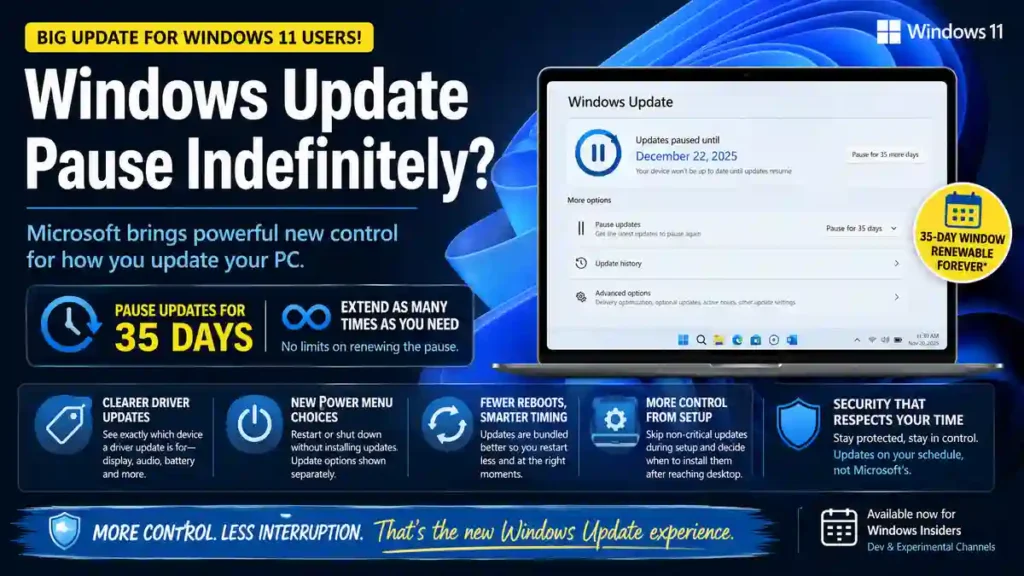
The idea of Windows update pause indefinitely may soon move from rumor to reality. Microsoft is testing a major overhaul of the Windows 11 update system, giving users far more control over how and when updates are installed. If rolled out widely, this change could make Windows updates feel much less intrusive.
Microsoft Testing Renewable Windows Update Pause
Microsoft has introduced a redesigned Windows Update experience in the Windows Insider Dev and Experimental channels that lets users delay updates for up to 35 days at a time. What makes this feature notable is that the pause can be extended again and again, with no fixed cap on renewals. In practice, that means users could keep postponing updates for as long as needed, creating what many are calling a near indefinite update pause.
According to Microsoft, if users don’t renew the pause once the period expires, updates will resume and install as normal. This keeps security protections intact while giving people much greater scheduling freedom.
Windows 11 Updates Are Becoming Less Disruptive
Alongside the extended pause option, Microsoft is also working to make updates feel less disruptive in everyday use. Driver updates will now come with clearer labels, showing whether an update relates to display hardware, audio components, battery systems or other devices. That added clarity should help users better understand what’s being installed.
Another notable change is coming to the Windows 11 power menu. Instead of pushing update-related shutdown options in a confusing way, standard Restart and Shut down choices will remain visible at all times, while “Update and restart” or “Update and shut down” will appear separately when needed. This means users can power off or reboot without feeling forced into installing updates immediately.
Fewer Restarts and Better Timing Control
Microsoft says it is also trying to reduce how often updates interrupt users. By coordinating downloads and installations more efficiently, the company aims to bundle updates together so devices require fewer reboots. Updates may continue downloading in the background, but the process should feel smoother, with clearer moments to install and restart.
New PCs could benefit as well. During initial setup, Microsoft is testing options that let users skip certain non-essential updates and reach the desktop first before deciding when to install them. It’s another sign the company wants updates to work around users, rather than the other way around.
Why This Change Matters for Users
For years, Windows updates have been important for security, but they have also frustrated users by appearing at inconvenient times—during meetings, gaming sessions, live streams or important work. That tension between security and convenience has often led to complaints.
By introducing renewable update pauses and giving people more control over restarts, Microsoft seems to be recognizing that timing and usability matter just as much as protection. Rather than forcing updates on Microsoft’s schedule, the system could start adapting to the user’s schedule.
When Could It Roll Out?
Right now, these features are limited to Windows Insider testers, and Microsoft could still adjust how they work before releasing them broadly. But if feedback remains positive, these changes could arrive in a future Windows 11 update for everyday users.
Final Thoughts
If this approach reaches the stable version of Windows, it could mark one of the most practical improvements Microsoft has made to its update system in years. With more flexible pauses, fewer forced restarts and clearer update controls, Windows updates may finally become something users manage comfortably instead of something they constantly work around.