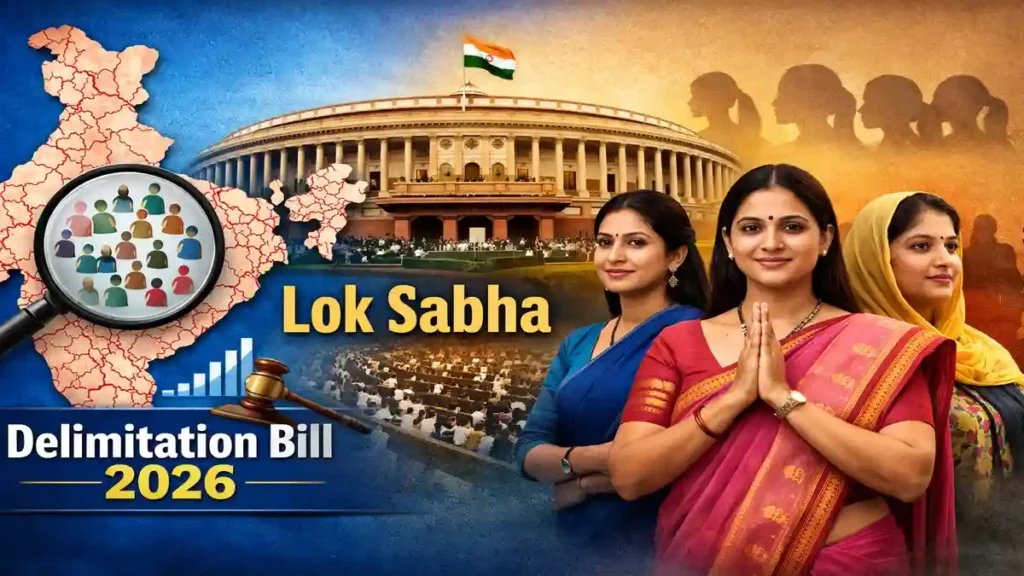
The Delimitation Bill 2026 is becoming one of the most discussed political topics in India. With upcoming electoral reforms and the implementation of the Women Reservation Bill, delimitation is expected to reshape the structure of the Lok Sabha and state assemblies.
This issue is crucial because it directly affects political representation, seat allocation, and democratic balance across states. As population dynamics have changed significantly over the decades, delimitation aims to ensure fair and equal representation for every citizen.
In this article, we will explain what the delimitation bill is, how the Delimitation Commission of India works, its impact on the Lok Sabha, and how it connects with the women reservation quota formula.
What Is the Delimitation Bill?
The Delimitation Bill refers to a legislative proposal that enables the redrawing of boundaries of parliamentary and assembly constituencies based on updated population data.
Delimitation ensures that:
- Each constituency has a roughly equal population
- Representation remains fair and balanced
- Electoral boundaries reflect demographic changes
In simple terms, delimitation is like reorganizing electoral maps so that every vote carries equal weight.
Major Changes Expected Under Delimitation Bill 2026
The Delimitation Bill 2026 is expected to come into effect after the freeze on constituency reorganization ends in 2026. Since 1976, India has paused delimitation to encourage population control measures across states.
Once implemented, this bill may:
- Increase the number of seats in the Lok Sabha
- Redistribute seats among states based on population
- Impact political power balance between northern and southern states
States with higher population growth, such as Uttar Pradesh and Bihar, may gain more seats, while southern states may see relatively slower growth in representation.
Delimitation Commission of India: Role and Function
The Delimitation Commission of India is an independent body responsible for carrying out the delimitation process.
Key Functions:
- Redrawing constituency boundaries
- Allocating reserved seats for SC/ST categories
- Ensuring fair representation based on census data
Important Features:
- It operates independently of political influence
- Its decisions cannot be challenged in court
- It works based on the latest Census data
The commission is typically headed by a retired Supreme Court judge and includes Election Commission members.
Impact on Lok Sabha Seats
The Lok Sabha, the lower house of Parliament, currently has 543 elected seats. However, after delimitation in 2026, this number could increase significantly.
Possible Changes:
- Expansion of total Lok Sabha seats
- Redistribution based on population
- Shift in political dominance
Why It Matters:
- More populous states may gain greater influence
- Smaller states may demand safeguards
- National politics could see major realignment
This makes the delimitation bill highly sensitive and politically significant.
Connection with Women Reservation Bill
The Women Reservation Bill, officially known as the Nari Shakti Vandan Adhiniyam, proposes reserving 33% of seats in the Lok Sabha and state assemblies for women.
However, its implementation is directly linked to delimitation.
Why Delimitation Is Required First:
- Reserved seats for women must be allocated after redrawing constituencies
- Fair distribution of women’s quota depends on updated electoral boundaries
Without delimitation, implementing the women reservation system would not be structurally accurate.
Lok Sabha Women Quota Formula Explained
The Lok Sabha women quota formula determines how 33% reservation will be distributed.
Key Points:
- 33% of total seats reserved for women
- Reservation applies to both general and SC/ST categories
- Seats will rotate after each delimitation cycle
Example:
If Lok Sabha expands to 600 seats after delimitation:
- 200 seats will be reserved for women
- These seats will be distributed across states proportionally
This system aims to increase women’s participation in politics while maintaining fairness.
Challenges and Controversies
While the Delimitation Bill 2026 promises fair representation, it also brings several concerns that cannot be ignored. Many experts and political leaders believe that the process, if not handled carefully, could create new tensions instead of solving existing issues.
Major Concerns:
1. North vs South Divide
One of the biggest debates around delimitation is the growing gap between northern and southern states. Southern states like Tamil Nadu and Kerala have successfully controlled their population over the years. However, they fear that despite their efforts, they might lose seats in the Lok Sabha, while states with higher population growth could gain more political power. This has raised questions about fairness.
Why Delimitation Is Important for Democracy
Democracy works best when every citizen’s voice carries equal weight. However, over time, population changes can create imbalances where some constituencies have far more voters than others. This is where delimitation plays a crucial role.
Delimitation is not just a technical process—it is a way to keep the democratic system fair, relevant, and representative of real population trends.
Future of Delimitation in India
The year 2026 could mark a turning point in India’s electoral history.
What to Expect:
- New political equations
- Increased representation in Parliament
- Greater participation of women in politics
Experts believe that delimitation, combined with the women reservation bill, can modernize India’s democratic system.
Conclusion
The Delimitation Bill 2026 is not just a technical reform—it is a major step toward reshaping India’s political landscape. By redefining constituency boundaries and enabling the implementation of the Women Reservation Bill, it has the potential to bring more fairness, inclusivity, and balance to the democratic process.
As discussions continue, citizens, policymakers, and political parties will need to carefully evaluate its impact to ensure that the spirit of democracy remains strong and inclusive.